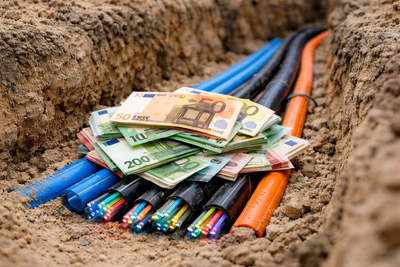
The nationwide rollout of fibre networks in Germany represents a major financial challenge for the companies involved in network deployment. In addition to the initial rollout, which will require investments in the double-digit billion range over the coming years, the densification of existing networks will also necessitate several billion euros in further investment.
Against this backdrop, financing options and conditions are increasingly moving to the centre of discussions within the fibre industry. In a macroeconomic as well as sector-specific environment that remains challenging, a number of market participants find themselves required to raise investment capital both for the refinancing and continuation of existing projects and for the initiation of new ones.
This discussion paper analyses which forms of financing are used by companies of different sizes, business models and ownership structures, the terms on which they obtain financing, and the extent to which higher interest rates and investor restraint affect these companies. It becomes evident that investor-financed companies are more strongly affected by the deteriorated financing environment than publicly listed companies or subsidiaries of municipal utilities and energy providers. At the same time, there is a clear link between financing-related challenges and problems at the operational level, most notably low take-up rates and increased construction costs.
Finally, potential remedial measures are discussed. These include both risk-absorbing public measures on the financing side, such as (partial) guarantees or an expansion of subordinated lending by development banks, as well as measures that could potentially improve companies’ business cases, including a clearly regulated copper-to-fibre migration and the acceleration and digitalisation of permitting processes.