
The study examines the energy- and emission-related effects of the migration from copper- to fibre-based access networks in Germany in the context of the climate objectives of the European Green Deal, which targets climate neutrality by 2050. The study’s aim is to quantify the CO₂ emissions of the fibre roll-out in Germany and subsequently achievable efficiency gains through copper-fibre migration. Suitable measures for the telecommunications sector are derived on the basis of scenario-based model calculations.
Methodologically, the analysis is based on a bottom-up modelling approach. First, detailed network dimensioning is used to determine the quantities of passive infrastructure required for FTTH/B deployment as well as the active network components for network operation. Network operation is differentiated by access technology and updated over time through a model-driven copper-fibre migration. Subsequently, quantities of network elements are linked to technology-specific electricity consumption and emission factors in order to derive the energy consumption and CO₂ emissions of network deployment and operation until 2050.
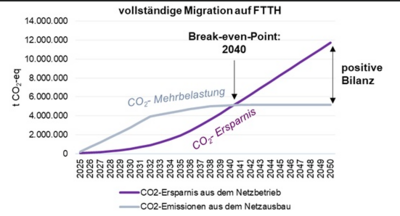
The model results show that a complete migration to FTTH has relevant energy saving potential, which will completely offset the emissions from the fibre optic expansion by 2040, thus achieving a positive net CO₂ balance by 2050. Retaining FTTB, DOCSIS and mobile connections could jeopardise the goal of climate neutrality for German access networks. An increasing decarbonisation of the electricity mix, on the other hand, can act as a multiplier for achieving CO2.