
Mobile telecommunications networks must adapt frequently to changing user demand because they rely on scarce frequency resources. The permanently increasing data volume per user is the main issue, followed by the increasing demand for better quality, especially with regard to transmission latency and reliability. All of this will be predominantly determined by the Radio Access Networks (RAN).
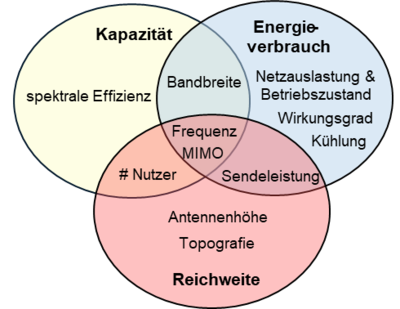
To adapt to the increasing demand, new radio interfaces will be introduced with new and more powerful coding methods, new antenna techniques and additional frequency blocks in higher frequency spaces. Higher frequency bands (bearer frequencies) have different emission characteristics regarding reach, susceptibility to noise and the presence of obstacles such as walls, line-of-sight interruptions caused by landscape/surface features, trees/forests or buildings.
These new technologies and frequency resources offer significant bandwidth improvements and transmit traffic more efficiently. New coding and antenna techniques offer significantly higher data transmission capacity. However, they do have different power consumption demands.
Based on experience of modelling energy demand in existing mobile networks, the study describes the interdependencies of changing user and power demands, taking into account new, more energy-efficient technologies, new frequency blocks and radio cell densification.
Consequently, it is predicted that the total power consumption of mobile networks will increase significantly due to the substantial increase in demand, which exceeds the substantial increase in the energy efficiency of telecommunication network elements. These effects can be counteracted by improving the interaction between smartphones and Wi-Fi access points for mobile offloading, thus reducing the load on the mobile network.