
The paper addresses the implementation of the fibre coverage target in Germany. In accordance with the coalition agreement, the German government is aiming for comprehensive fibre coverage in every home (FTTH). The principle of ‘market before state’ applies here, according to which state aid programmes should be used where market-driven roll-out is not possible. This study examines the incentive effects of the current institutional regime and the interaction between commercially viable roll-out and subsidies.
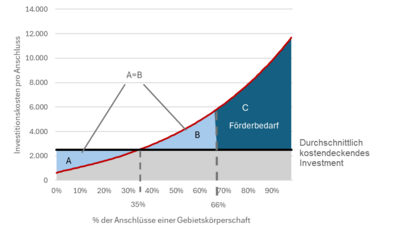
The monitoring report on the status of fibre network roll-out in Germany indicates that the commercial roll-out of various operator categories observed in the market lags behind the commercially viable potential. This can be explained economically on the basis of the incentive structures analysed: profit-oriented fibre network operators have incentives to cherry-pick when commercially viable roll-out takes precedence in the competition with other operators. The subadditive cost structures of connection networks mean that once an entrepreneur has developed the economically attractive areas, other operators no longer have the cross-subsidisation potential necessary to cover the costs of deploying the remaining areas. As a result, the commercially viable roll-out potential is not fully exploited. This cherry-picking, along with the fact that eligibility for support is not determined a priori but on a case-by-case basis and successively upon application, goes hand in hand with economic incentives that lead to excessive demand for funding.